Monday, January 16, 2012

Pancit Salad [GF]

In day-to-day Hawai'ian culinary life, the noodle salad is a staple.  If not in itself, as may deem it, the backbone of any plate lunch worth its salt (and that's usually a lot of salt), it's at least a vertebra on a par with the gravy, the meat, and the two scoops of rice.  While your typical plate-lunch noodle salad is macaroni-based, the gluten-intolerant among us will be glad to see a viable alternative (in the form of a pancit salad — pancit bihon being a type of ultra-thin rice noodle used in Filipino cuisine) that is wheat free and equally respectable as local food.  And as for the creamy sauce, the morsels of chicken, fish, or seafood, and the minced tomatoes — never fear: they're here in full force.

The recipe provided below yields a single serving of the salad.  I originally made a bowl of this salad a week or so ago, but have maintained a strong hankering for it ever since, and have created three variants so far: one featuring chicken breast, one featuring tuna, and one featuring mussels (the rest of the ingredients, and their proportions, have been held constant as the protein source has been varied).  The mussels have so far been my favorite, but all have been outstanding.  Also, I should point out that the reason I elected to use pancit, rather than any other form of rice noodle, is that I just happened to have some lying around.  I suspect that rice macaroni might even be a better vehicle for the mayonnaise-based sauce, and would, at any rate, add to the mac-salad authenticity and caché of the dish.

Curly cress, incidentally, which is called for in this recipe, and which occasionally also goes by the aliases "garden cress" and "pepper grass," is a piquant, peppery micro-green.  It shows up not infrequently at farmers' markets on O'ahu (credit for the bunch I used in constructing this recipe, in all three of its incarnations, goes to the folks at 'Nalo Farms, who also, I should add, raise a damned fine corn sprout), but, as with many of Hawai'i's agricultural delights, I'm not sure about its wider availability.  If you can't find it, don't worry too much: it's not an essential ingredient in the salad, but it does complement the other flavors quite nicely, and provides a bit of textural variety to an otherwise overwhelmingly creamy dish.  Other sorts of cress might serve as reasonable substitutes as well, for what it's worth. 
  • 1 oz. dry pancit noodles
  • 1-1½ oz. diced grilled chicken breast, cooked mussels, or canned tuna
  • 1 tsp. mayonnaise
  • ½ tsp. Tabasco sauce
  • 1½ Tbsp. dijon mustard
  • 1 Tbsp. rice vinegar
  • ½ Tbsp. fresh cilantro, chopped
  • 1 tsp. curly cress, chopped
  • 1 Tbsp. tomato, chopped
  • ¼ tsp. dry dill weed
  • ⅛ tsp. dry basil
  • ¼ tsp. sweet paprika
  • 1 generous pinch ground cayenne pepper
  • ⅛ tsp. black pepper, coarsely ground
  • ⅛ tsp. salt, or to taste
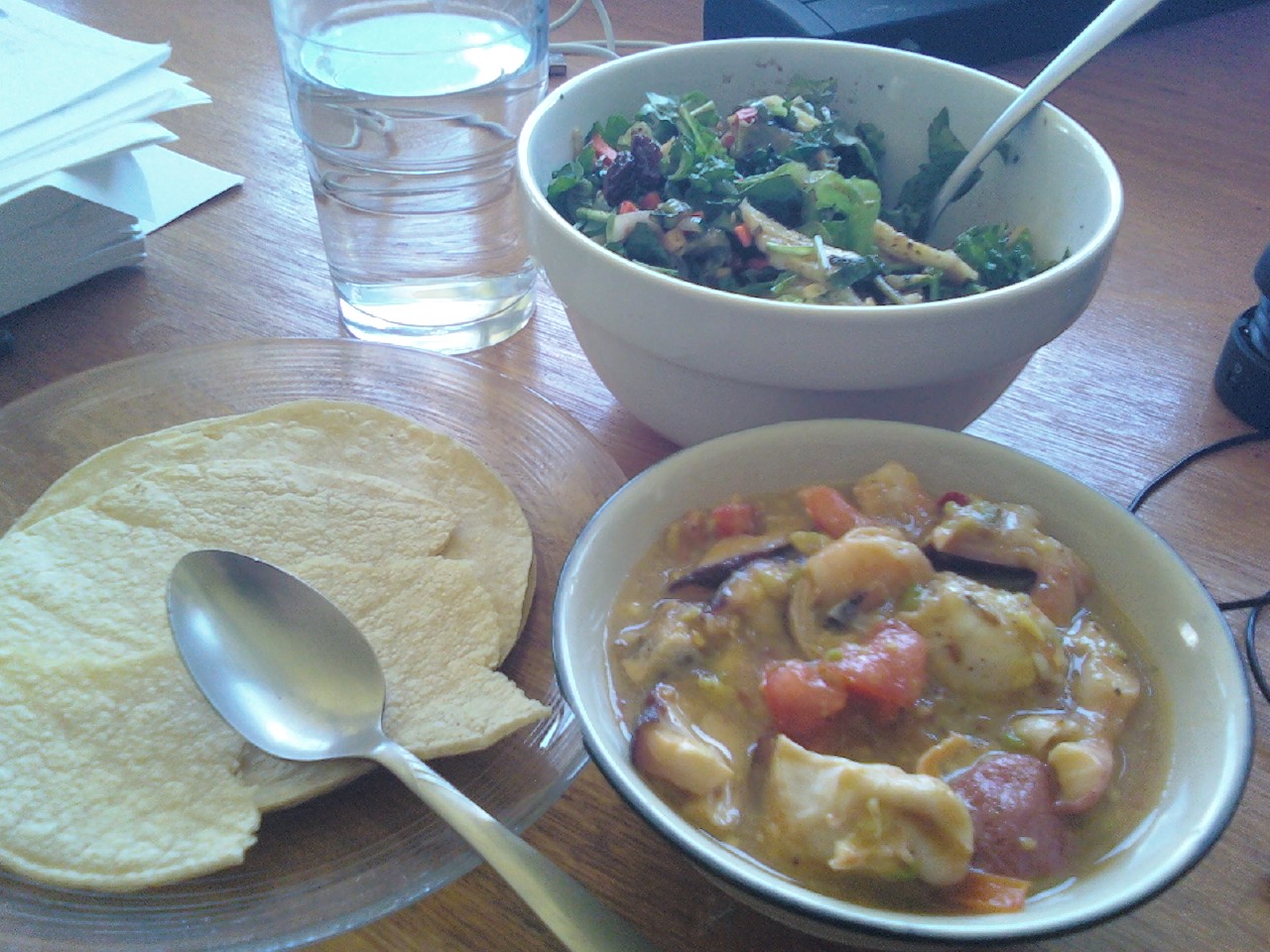
Bring a small pot of water to a boil in order to cook the pancit.  While the water is boiling, combine the rest of the ingredients in a small bowl and mix them together thoroughly.  Once the water is boiling, place the dry pancit noodles in the water and cook thoroughly.  Once the noodles are cooked, strain them and allow them to cool for a few minutes, then add them to the bowl and stir them into the sauce thoroughly.  Serve either with other components of plate lunch, or else with a simple side salad, as shown in the photo above. 

    Sunday, January 8, 2012

    Ginger Carrot Soup [V] [GF]

    This soup recipe sort of came to me out of the blue as a preliminary course to be served prior to a main course of vegan stroganoff.  It has a hearty, autumnal flavor and could also go well with poultry or other traditional fall meals.  Like the stroganoff with which I paired it, it's completely vegan and, if it's appropriate for me to offer my extremely biased opinion, quite tasty.  It's also reasonably easy to make, although the cooking of the lentils, which form the backbone of the soup base, takes a little bit of time.
    • 3 medium carrots, coarsely chopped
    • 1 medium seedless orange, peeled
    • ¼ cup frozen sweet corn
    • ⅛ cup dry yellow lentils (toor dal)
    • 1 Tbsp. peanut oil
    • 1½ tsp. dry ginger
    • 2 tsp. salt, or to taste
    • ½ tsp. dry basil
    • ⅛ tsp. poultry seasoning
    • ¼ tsp. dry rosemary leaves
    • ¼ tsp. turmeric
    • 1 pinch nutmeg
    • 1 pinch cloves
    • 1 pinch allspice
    Place the oil in the bottom of a medium saucepan and fry the ginger, allspice, nutmeg, cloves, and poultry seasoning in the oil for 2-3 minutes on medium head. Add 3 cups water and the lentils and bring them to a boil for approximately an hour, or until the lentils are cooked, adding water as necessary in order to maintain a constant volume of stock. Twenty minutes into this cooking process, add the rosemary, pepper, and salt. While the lentils are cooking, process the carrots and the orange together in a food processor until the mixture is essentially homogeneous. When the lentils have finished cooking, turn the heat down to medium and add the carrot-orange mixture and the corn to the saucepan. Continue cooking for 5-10 minutes until the corn and carrots are cooked. Serve hot.

    Vegan Stroganoff [V] [GF]

    Holiday gatherings can be a time of fruitful culinary experimentation, especially if you're planning on serving a meal to a group of people with a wide variety of dietary habits.  Traditional dishes that one might have a yen to serve at such gatherings (especially European ones) often require a bit of tweaking in order to be acceptable to all parties, while they must faithfully mimic the traditional textures and flavors the purists amongst your dinner guests have come to expect.  Thus, this evening, necessity became the mother of vegan stroganoff.  The recipe provided below is an attempt to reconstruct a passable replica of beef stroganoff without the beef, without true sour cream, and without animal products of any sort.  In it, mushrooms create the savory flavor, silken tofu takes the place of sour cream, and soy sauce provides the critical brown-gravy coloration.

    In the recipe below, Earth Balance was the vegan butter substitute I used, while the poultry seasoning mix was a Schilling-brand mixture whose primary two ingredients were thyme and sage.  This sauce can be served over noodles (made either of wheat or, if one is of the gluten-free persuasion, rice), as beef stroganoff typically is, or over rice.  Really, just about any complex carbohydrate could serve as a vehicle for this stuff in a pinch — even tortilla chips, if you're desparate.  As you can see from the photo, I served it with baked asparagus spears (graced by a touch of pepper, lemon juice, and olive oil) and the unused riesling.  No one complained.  
    • 22 oz. silken tofu, extra firm
    • 2 lemons
    • 1½ Tbsp. vegan butter substitute
    • 16 oz. mushrooms, coarsely chopped
    • ½ cup dry riesling
    • ¼ cup frozen peas
    • ¼ cup diced celery
    • 1 tsp corn starch
    • 2 tsp. gluten-free soy sauce
    • 1 Tbsp. black pepper
    • 1 Tbsp. dry basil
    • ¼ tsp. dry rosemary leaves
    • ¼ tsp. poultry seasoning
    • 3 tsp. salt, or to taste
    Begin by melting the butter substitute in a large frying pan and sautéeing the mushrooms until they're brown and moderately soft.  While the mushrooms are browning, combine the silken tofu, the juice of the lemons, and 1 tsp. of the salt in a food processor and process until the mixture is well-blended.  Set this mixture aside.  Add the salt, pepper, herbs, and celery to the frying mushrooms and cook for 2-3 minutes or until the celery is soft.  Add the wine and simmer on medium heat until much of the liquid has evaporated.  Stir in the corn starch so that it doesn't clump and continue to simmer until the liquid in the pan has a gravy-like consistency, then add the peas and continue to simmer for a few more minutes.  Reduce to low heat and add the tofu mixture from the food processor to the frying pan, stirring it thoroughly into the mushrooms, etc. already present in the pan.  After roughly 5 minutes, when the mixture is hot, stir the soy sauce into the mixture in the frying pan.  Salt to taste and serve over rice noodles.  

    Friday, December 2, 2011

    Spam and Eggs with Fried Okra [GF]

    Succinctly put, Hawai'i loves Spam, and after an initial phase of incredulity, so do I.  While some may scoff at this potted meat product, life without it is incomplete, and with it, an abode of bliss.  Furthermore, as a Minnesotan dwelling on O'ahu, I'm pleased to see such appreciation for what is my home state's best answer to the quandary of what to do with miscellaneous processed pig parts.  However, Spam must be prepared correctly in order to bring out its finest attributes; to wit, it must be fried, then paired with complementary ingredients which bring out its best attributes.  Pineapple is a good choice.  Rice and seaweed are equally respectable (and for those who have yet to experience the majesty of musubi, this random video tutorial set to soothing reggae will help to invest significance your currently meaningless existence).  Eggs and okra, however, are the subject of today's recipe post, and rival the divinity of either of the above combinations.

    From my perspective, the recipe provided below makes two servings, but I would imagine that the average American with an average appetite would consider this a single serving — especially if no other dishes appeared alongside it on the breakfast table, save for, say, perhaps a piece of toast.  I'll also say that substituting dried, shredded nori for the kale (a variation I have tried... and repeated) yields an equally fine repast. 
    • 1 cm thick slab of Hormel's finest (yes, that would be the Spam), diced
    • 2 eggs
    • 1 tsp. plain soy milk
    • ⅛ tsp. salt (or to taste)
    • 2 large okra pods cut into thin, cross-sectional slices
    • ¼ cup fresh baby kale, cut into small pieces with stems removed
    • 2 medium-sized "baby bella" mushrooms, diced
    • 3 pinches coarsely ground black pepper
    • 2 pinches dry basil
    • half of a small thai chili pepper, diced
    • 6 drops Cholulu brand hot sauce
     Fry the Spam, mushrooms, and okra in a small frying pan in a small amount of canola oil (or other vegetable oil) on medium heat.  Break the eggs into a small bowl, add the soy milk, and beat for a few seconds with a fork or wire whisk until the yolks have broken and are thoroughly mixed with the whites and the soy milk.  After five minutes, or when the Spam and okra have browned, add the chili pepper.  After another minute or two, pour the egg mixture in and scramble the eggs into the Spam, mushrooms, and okra.  Add the pepper, salt, and hot sauce and continue to scramble until the eggs are cooked.  At the last minute, add the kale and the basil and stir until the kale begins to soften, then remove from heat while continuing to stir for a minute or so more.  Serve immediately.

    Sunday, November 20, 2011

    Chard Salad with Moroccan Spices

    I'll confess I've never really seen much chard in Morocco, even after a year's residence there, and I'm not even sure it's something the climate could support if people felt the urge to grow it there.  That notwithstanding, certain spice combinations can bring out the best from the most unexpected of foods, and while it might just be that I happened to be in possession of some truly exceptional cumin (courtesy of Penzey's, of course), which did a great deal for this simple recipe, I surmise that whatever your cumin quality, you'lll be pretty pleased with the results.  Full disclosure: this recipe was adapted from the one provided here, which I discovered while trolling the internet for good uses for the excess chard I picked up at the Kapiolani Community College Farmers Market yesterday morning on a whim.
    • 1 large bunch fresh chard
    • ¼ tsp. extra-virgin olive oil
    • 1 tsp. ground sweet paprika
    • ½ tsp. ground cumin
    • ¼ tsp. salt (or to taste)
    • ⅛ tsp. finely ground black pepper
    Set a small, half-full pot of water on to boil.  Coarsely chop the chard. Once the water boils, add ½ tsp. or so of salt to the water, followed by the chopped chard, and boil for 15 min. or until the stalks are soft. Dump the chard into a colander and run cold water over it until it cools down enough to handle without discomfort. Wrap the chard in a paper towel and wring out as much water from it as possible. Return the wrung-out chard to the chopping board and chop even more finely. In a bowl, mix the chard, oil, salt, and spices thoroughly. Serve immediately at room temperature.

      Mussel Mayonnaise Poke [GF]

       One of the first things I'd resolved to do upon my recent return to Hawaii, after more than a month abroad roaming the arid steppes of northern China, the maize-laden plains of central Minnesota, and the escalator-rich human hive of Hong Kong was to fix myself a good, down-home poke.  Moreover, in honor of my homecoming, I thought I'd experiment a little bit with some unusual variations on my usual sesame-oil-and-soy-sauce recipe.  Here's what I came up with: a poke which complements the creamy taste and soft texture of mussels with a piquant mayonnaise sauce, while at the same time doing justice to the mollusks' understated seafood flavor by combining them with a substantial amount of limu and just a hint of fish sauce.  I think this one will become a permanent addition to my poke repertoire.  Enjoy!   
      • 1 cup limu (ogo seaweed), chopped
      • ¼ lb. small mussels
      • 2 Tbsp. mayonnaise
      • 2 tsp. Tabasco-brand hot pepper sauce
      • 1 tsp. Cholulu-brand hot sauce
      • ¼ tsp. coarsely ground sea salt (or to taste)
      • ¼ tsp. coarsely ground black pepper
      • 2 tsp. fresh cilantro, diced
      • 6 raw macadamia nuts, minced
      • 1 tsp. rice vinegar
      • ½ tsp. sesame oil
      • ½ tsp. Vietnamese fish sauce
      Combine all ingredients in a small bowl and toss together.  Serve either immediately or after chilling for 15 min. in the refrigerator. 

        Friday, October 14, 2011

        Wild Rice, Turkey, and Split-Pea Soup [GF]

        One of the most unfortunate aspects of impromptu cooking is that one often creates a magnificent dish which one longs to replicate — or to assist others in replicating — but to which one either added the ingredients too hurriedly, or else in too incremental a fashion to allow for the reconstruction of a recipe with accurate proportions for all ingredients added.  This pea-based potage was such a dish, but one sufficiently tasty that I'm going to attempt a rough reconstruction of the recipe anyhow, in the hope that someone out there will be able to hone a Winged Victory of Samothrace, so to speak, from this proverbial rough, unhewn marble.  I prepared it in a pinch, after the ham for the ham-and-split-pea soup I'd been planning to make didn't materialize, but I think it probably trumps whatever the original concoction would have been.

        Again, before I list the ingredients, let me reiterate that the proportions given are at best conjectural.  The only things I know for a certainty are the net weight of the dry split peas and wild rice used.  I made the stock by boiling turkey bones a few hours prior to beginning preparations on the soup, and just transferred the broth in that pot over to the soup pot when needed.  I kept adding water, salt, and spices in increments throughout the cooking process.
        • 8 oz. dry split peas
        • 8 oz. wild rice
        • 5-7 cups unseasoned, unsalted turkey stock
        • 2 cups diced roast turkey (light and dark meat)
        • 3-4 Tbsp. salt (or to taste)
        • 1-2 Tbsp. black pepper
        • 2 tsp. sweet paprika
        • 1 tsp. dry parsley flakes
        • 2-3; tsp. Thai basil
        • 4-6 medium carrots, coarsely chopped
        • 3-5 cups water
        • 1-2 Tbsp. poultry seasoning
        • 1-2 tsp. dry rosemary needles, crushed
        • 1 tsp. white pepper
        • ½-1 cup red wine vinegar
        • ¼ cup lemon juice
        • 1-2 tsp. turmeric
        • 1-3 tsp. ground dry ginger
        • 2-3 tsp. dry oregano
        • ½ tsp. ground cloves
        Soak the split peas overnight prior to preparing the soup.  In a large soup crock, boil the soaked peas in the broth and two additional cups of water for 10-15 min. on high heat.  Reduce to medium-high heat and begin adding the cloves, ginger, salt, (white and black) pepper, turmeric, poultry seasoning, and paprika, lemon juice, and vinegar (doing so incrementally and adjusting the amounts to taste).  After 30-45 min. more, or when the split peas have softened and the broth is beginning to turn mildly green, add the wild rice, rosemary, oregano, Thai basil, and parsley (again, doing so incrementally and adjusting the amounts to taste).  After the wild rice becomes soft (which should take another 30-40 minutes), add the turkey and carrots, turn the heat down to medium, and continue to simmer until the carrots are tender but not overly soft.  While the carrots are cooking, once again adjust the seasonings to taste.  Once they are tender, remove the soup from the burner and serve.

        Again, I invite any interested readers who choose to undertake this recipe to weigh in on the issue of what the optimal proportions of the ingredients are.  Otherwise, bon appetit!   

        October Fool [V] [GF]

        I had remarked in my previous post, a moderately-sized pie pumpkin tends to provide a tad more gourd-flesh than needed for making one or two pies.  Perhaps this remark left certain readers in suspense as to what I would do with the remainder of the cooked pumpkin I had on hand after pie-making was complete.  Then again, perhaps I'm being narcissistic, and the hard truth is that nobody pays terribly close attention to half-implied narrative arcs in an only sporadically updated recipe blog.  Well, that may be, but at any rate, I'm going to satisfy your non-existent curiosity anyhow: I made October fool (to be contrasted with April fool, which is something else entirely).

        So, for those unfamiliar with the dessert known as "fool" (the etymology of whose name is somewhat hazy), it's generally a light, summery mixture of sugar, whipped cream, and pureed fruit.  This creation certainly fits the description, though the squash certainly gives it a weight and a more autumnal essence that its berry-based cousins lack.  The nice thing is that it requires little in the way of preparation (other than the initial cooking of the pumpkin, as discussed in the pumpkin-pie post) and equally little in the way of sugar.  In fact, eliminating the sugar from this dish entirely wouldn't drastically alter its character.  The recipe given below serves five.
        • 1¾ cups cooked pumpkin
        • 2½ bananas
        • ½ cup soy milk
        • 2 tsp. brown sugar
        • ½ tsp. cinnamon
        • ⅛ tsp. nutmeg
        • ⅛ tsp. salt
        • 1 Tbsp. finely chopped pecan pieces
        Place the pumpkin, soy milk, spices, salt, and bananas in a food processor and puree until the resulting mixture is smooth.  Spoon directly into small bowls or wine glasses and garnish with the chopped pecans.

          Sunday, October 9, 2011

          Old-Fashioned Pumpkin Pie [GF]

          The climate in which we dwell, and in particular that in which we spend our infancy and youth, yields the bulk of the timber from which the metaphorical architecture of our weltanschauung is constructed.  For those dubious of this assertion's veracity, I heartily recommend residing in some far-flung location whose climate is as close to diametrically opposite that of one's provenance as possible, and then returning to one's native land during a particularly captivating season, such as Autumn in the Upper Midwest.  Indeed, the word "autumn" is all but superfluous on the Hawaiian Islands, where the standard deviation in temperature appears to be in the single digits Fahrenheit and the difference between summer and winter has more to do with precipitation than temperature.  In the greater Minneapolis area, however, autumn is nothing less than the symbolic requital of spring's myriad promises: it is a harvest celebration in which nature herself supplies the banners the confetti, and the music (from the throats of Canada geese volant to the crepitation of workboots upon leaf-strewn pathways), coupled with an annual acknowledgment (that you can bet pervades the Minneapolitan psyche) that human lives themselves have their seasons and cycles, that those seasons have a dramatic arc to them, and that none of them lacks its industry and purpose.   

          These sentiments (bear with me here: the anthropology's nearly done and the recipe's coming...) are embodied in the region's traditional harvest foods: baked squashes, ears of gold-tasseled corn, roasted fowls packed with myriad forcemeats replete with nuts and dessicated cherries, and raw, tart apples to be broken vociferously between the teeth.  These are foods which heat the kitchen, foods far too cumbersome to prepare when only one lone diner is to sit at table and which therefore urge companionship and communion, foods rich in starches and sugars to sustain the eater through the coming dearth.  As trite as these symbols have become to most of us as a result of our collective elementary-school experience with Thanksgiving decorations and woefully historically inaccurate fables about pilgrims and helpful natives breaking bread, their symbolic power tends to get reinvigorated quickly after one is thrust into a Minnesotan autumn after many moons roaming abroad in lands without similar seasonality or seasonings.  In that spirit, one of my first culinary endeavors after arriving in Minnesota this fall was to produce from scratch perhaps the most hackneyed of the season's symbolic foodstuffs: pumpkin pie.


          Making a pumpkin pie from scratch is not particularly difficult, but a few tidbits of wisdom (gleaned from cookbooks of various sorts over the years) should be passed on to the reader who has never attempted to do so before.  As far a pumpkins go, seek out pie pumpkins rather than carving pumpkins — provided you can find them.  If you're physically located in Hawaii, or some other location in which pie pumpkins aren't east to come by, I've read (though have not personally verified) that kombucha do quite well in their stead.  The only thing keeping this recipe from being vegan is the eggs, for which many apt substitutes also exist.  The recipe I've provided below makes two smallish pies.  Pie pumpkins, unfortunately, are quantized in units which tend to yield far more pumpkin flesh than require for even a pair of pies, so feel free to do what you will with what remains.  As a final comment, if you're not particularly keen on steaming as a method for cooking your pumpkin (do to time constraints or any other reason), several alternative methods (including one involving a microwave oven) can be found here.

          Pie filling:
          • 1 small pie pumpkin
          • 2 cups vanilla soy milk
          • 3 eggs
          • 1 tsp. Torani hazelnut syrup
          • ½ cup white sugar
          • ½ tsp. cinnamon
          • ¼ tsp. nutmeg
          • ¼ tsp. dry ginger
          • ¼ tsp. nutmeg 
          Slice the pumpkin in half and remove the seeds and strands of pumpkin innards.  (If you don't want to waste the seeds, I suggest cleaning and roasting them, but this is a subject for a subsequent post.)  Wash the halves off and further slice each into five or six large slices or chunks so that all can be fit together into one large pot.  Place the chunks into such a pot with a cup or more of water at the bottom and steam the slices in this manner on medium heat for 30 min. or so, or until the pumpkin flesh is soft and can be removed from the rinds with a spoon.  Separate around three cups of the pumpkin flesh from those rinds, place it in a food processor with the soy milk, and process the two together until the puree is of a uniform consistency and all chunks of pumpkin have been broken up.  Pour into a mixing bowl and combine with the other ingredients.  Stir the mixture vigorously, taking particular care to mix the eggs into it thoroughly.   

          Prepare the (rice-flour based) pie crusts by following the recipe given in the my pineapple-pie post from back last December.  Once the pie crusts are satisfactorily pre-baked, remove them from the oven to cool and turn the oven temperature down to 375°.  When the pie crusts have cooled sufficiently, pour the filling into them, cover each pie with aluminum foil, and return them to the oven for 25-30 min.  Remove the foil cover from each pie and continue to bake for another 25-30 min. or until a knife stabbed through the center of each pie remains clean when withdrawn.

            Thursday, October 6, 2011

            Indonesian Squid Broil [GF]

            Last month, while attending a conference in the greater Chicago area, I had the opportunity to drop in on what is fast becoming one of my favorite restaurants.  This would be JoyYee, an establishment which does better than any other to dispel the "jack of all cuisines, master of none" stigma that plagues (and admittedly, in most cases, deservedly so) pan-Asian eateries.  Having dined there (if partaking in boba smoothies and appetizers counts as dining) there three times in the span of a week, I had the opportunity to explore vast tracts of their extensive menu and came away with a burning desire to replicate one particular dish, which consisted of a whole grilled cuttlefish adorned with a thick black sauce.  Soon after I returned to O'ahu, a friend's visit afforded me the opportunity to try my hand at what I am guessing was probably inspired primarily by an Indonesian dish called cumi kecap.

            The results... well, suffice it to say that I rank this as one of the ten best dishes I have ever created.  Two other parties offered similar, glowing reviews.  While the dish did not precisely replicate JoyYee's cuttlefish, all unanimously agreed that it surpassed the dish which inspired it in nearly every way — which given the already high quality of the original, is high praise indeed.  But enough vaunting: let's get to the recipe.

            The Squid:
            • 1 whole medium squid
            • ½ tsp. soy sauce
            • ⅛ tsp. salt
            The Sauce:
            • 3 Tbsp. gluten-free soy sauce
            • ¼ tsp. fish sauce
            • 2 Tbsp. water 
            • 1 Tbsp. cooking sherry
            • ½ tsp. sesame oil
            • 2 tsp. raw cane sugar
            • ⅛ tsp. salt
            • 1 pinch cinnamon
            • 1 pinch cardamom
            • 1 small pinch cumin
            Set the oven to broil and preheat it to 375° Fahrenheit. Rinse the squid under cold water and remove the eyes, beak, and digestive organs with a knife.  Grease a suitably-sized cookie sheet with sesame oil.  Place the entire squid on it, sprinkle half of the salt and soy sauce over it, and broil for 15-20 min.  While the squid is cooking, combine the soy sauce, fish sauce, oil, cardamom, cumin, and cinnamon in a small saucepan and simmer on medium heat, stirring frequently, until the mixture attains the consistency of molasses.  Remove the squid from the oven, flip it over with a spatula, and sprinkle the remaining soy sauce and salt on the newly exposed side.  Return the squid to the oven for another 15-20 minutes or until the exterior is browned but the flesh is still tender.  Add the remaining ingredients to the sauce and continue to reduce the mixture, while stirring frequently, until the squid is done.

            Place the squid in a shallow bowl or serving dish and pour approximately half of the sauce over it.  Transfer the remaining sauce to a small bowl for dipping the rings and tentacles in.  Serve with rice (which can also benefit from the use of the remaining sauce as condiment).               

              Sunday, September 11, 2011

              Dates Wrapped in Hickory-Smoked Chicken Skin [GF]

              This monstrosity is easily the unhealthiest culinary creation I have ever described on this blog, and will likely remain so for a long time.  Like its close cousin and primary inspiration dates wrapped in bacon (a dish which appeared among the hors d'ouvres offered at a reception during a conference I recently attended and has been lingering in my thoughts ever since), it is essentially an excuse to clothe a cloyingly sweet dried fruit morsel in a raiment of "meat candy" — one of those segments of animal flesh into which the Creator has, in his infinite wisdom, elected to concentrate both flavor and fat.  (And yea, the Lord saw that it was good; at least until he who consumeth it dieth of a massive coronary.)

              One quick disclaimer before I narrate the recipe: my primary motivation for preparing this dish was that I happened to have recently engaged in smoking a chicken, and therefore had a substantial quantity of chicken skin lying around that I didn't really know how else to put to good use.  To be honest, I still deem that the bacon-based version of this hors d'ouvre to be the superior specimen: while the hickory-smoke flavor of the chicken skin provides a sublime compliment to the flavor of the dates, the texture leaves a bit to be desired.  The skin of smoked poultry tends to be a tad tough, and as a result these morsels tend to be a bit on the chewy side.  Nevertheless, I believe the principle of wrapping dried fruit in the skins of fowls has merit, and am looking forward to an experiment in dressing figs in turkey skin this Thanksgiving.    
              • Skin from a hickory-smoked chicken, cut in 1" × 1" strips
              • 15 - 20 large, pitted medjool dates
              • 1 Tbsp. orange-blossom honey
              • 1 Tbsp. pecan pieces
              • 1 Tbsp. potato starch
              • ½ tsp. salt
              • ½ tsp. ground cinnamon
              Preheat an oven to 300°. Take each date and make a small hollow in the center by inserting the tip of a wood or bamboo skewer into the hole from which the pit was removed.  Pack a few pecan pieces into this hollow.  Wrap the chicken skin around each date and secure it by tanspiercing the date and the chicken skin with a bamboo skewer.  After assembling skewers of 5-8 dates each, place them on a cookie sheet or baking pan for five minutes or until warm.  Remove the skewers from the oven, coat the warm dates evenly with the honey, and then sprinkle them with the cinnamon, salt, and potato starch (in that order).  Return the skewers to the oven and bake for 15-20 min. until brown.

              As a final note, if you intend to serve this item as an hors d'ouvre at some soiree you're putting on, I might suggest using a toothpick to secure the covering to each date individually rather than attempting to bake them  on skewers en masse and serve them from those skewers churrascaria-style at your gathering.  They tend to be a bit sticky and frequently fall apart when removed from the skewer.      

                Monday, August 15, 2011

                Breakfast on Ice: a Survey of Fruits (Part 2)


                Here's yet another update on some rather unusual fruits that one can find in Honolulu farmers' markets (and specifically, the Kapiolani Community College Farmers' Market just north of Diamond Head, where I encountered a phenomenal fruit stand specializing in unusual specimens from Asia, Central America, and God knows where else).  Anyhow, the question remains: how do these specimens fare in fruit smoothies?  Well, I'm glad you asked...

                Canistel

                The canistel is one of the oddest culinary specimens I've run across in local markets to date.  Yet another Mesoamerican specimen, the canistel has a flavor (and a texture) eerily similar to that of pumpkin, only sweeter.  However, its flesh is creamier than a baked pumpkin's, and perhaps the overall experience of eating a canistel is roughly a midpoint between eating pumpkin and eating pumpkin pie.  So yes... they're a bit starchy, and a canistel smoothie can be pretty filling, but it can also be practically ambrosial if done correctly (with a little brown sugar added).  So starnge, yes, but the canistel was one of the most pleasurable produce discoveries for me in many months.  Two enthusiastic thumbs up!  


                Mamey Sapote

                Similar to the chiku in texture (creamy), flavor (custard-like with chocolate overtones), and provenance (Mexico and Central America) but larger, the mamey sapote is a fruit I learned to love during repeated sojourns in Mexico city, but have seldom if ever encountered since.  However, upon seeing them for sale at this last weekend's KCC farmers' market, I knew I couldn't pass up the chance to conver them into liquid breakfast — and the result surpassed even my high expectations.


                Mamey Apple 

                The mamey apple takes a while to ripen, but when it finally does, it provides a bright flavor halfway between that of an apricot and that of a nectarine, but with a little bit of extra ascorbic acid flavor.  Not bad in a fruit smoothie (especially when lehua honey is added), but not quite strong enough that I'd recommend this method of consumption over simply cutting pieces off with a knife and eating them. 

                So once again, that's it for this week's roundup.  Stay tuned for further updates as a new set of autumnal fruits begin appearing at a stand near you (or at least near me).

                Soy-Custard Flan Tarts [GF]

                With a plethora of eggs in my possession and an invitation to a garden party imminent, I finally had a perfect opportunity to attempt the soy-milk-based custard imitation I had long been hoping to turn into a flan-like reality.  As the guests at said garden party would certainly attest, the tiny pies which resulted from this experiment are yet another testament to the ability of soy milk to serve as a magnificent substitute for actual cow's milk in situations in which it really has no right to do so.  Indeed, while the consistency of the filling is admittedly more flan-like than creamy, this is actually an asset in terms of longevity: these tarts retain their consistency and flavor after refrigeration for a few days (or perhaps longer, but it's difficult to refrain from consume them for any longer duration).   

                The recipe given here yields enough crust and custard for four tarts.  These can be flavored in the same manner if you prefer, or you can easily flavor the portion of custard that is to become into each tart independently.  Some suggestions for combinations of flavorings and icings/toppings for the tarts are provided below, although I'm sure you can imagine plenty of other possibilities which would be just as tasty of better.   

                For the pie crust:
                • 1½ cups white rice flour
                • ½ tsp. salt
                • ½ cup vegan butter substitute
                • 4 Tbsp. water
                For the custard:
                • 3 eggs
                • ½ cup white sugar
                • ½ tsp. salt
                • 2 cups vanilla soy milk
                • 1½ Tbsp. flavored liquer or ½ tsp. flavor extract
                To make the crust, preheat the oven to 425°.   Mix the dry ingredients, cut the butter substitute into the mixture, and form the resulting mixture into crusts in four tart pans.  Bake the crusts for 10 minutes at 425°, remove from the oven, and allow them to cool to nearly room temperature.  Immediately upon removing the crusts from the oven, reduce the temperature to 350°.

                To make the custard, place the eggs, sugar, salt, and soy milk into a medium-sized mixing bowl and beat well with a wire whisk.  If your goal is to flavor the whole quartet of tarts in an identical manner, stir in the liqueur or flavor extract and partition the mixture into the crusts.  However, if your goal is to flavor each tart differently, you can also divide the custard mixture into four equal parts (each of which turns out to contain almost precisely 1 cup) and flavor each with a different extract or liqueur.  Once the temperature of the oven has decreased to around 350°, place the tarts on a rack in the center of the oven and bake for 35-45 min. until the custard has set into a flan-like consistency.

                Remove the tarts from the oven and place them on a rack or trivet on a countertop to cool.  Once they've cooled to slightly above room temperature, cover them with icing, jam, fruit, or whatever else you choose.  Ideally, these tarts should be served within about 30 minutes of preparation, if the goal is to serve them warm (they don't stand up terribly well to reheating).  However, if the goal is to serve them cold (which, given the similarity to flan, is actually a very good idea), they retain their initial consistency quite well even after refrigeration.

                Some of the topping and flavor-infusion combinations which I've either tried and deemed successful, or else which am sure would work brilliantly if I had had the ingredients on hand when I'd had the inclination to make a batch of these tarts, are listed below.

                Chocolate-peanut-butter icing:
                • ½ cup roasted peanuts
                • 3 Tbsp. unsweetened cocoa powder
                • 1 Tbsp. sugar
                • ¼ tsp. almond, hazelnut, or vanilla extract
                • ½ tsp. salt
                • ¼ cup water
                Place the peanuts in a food processor in process until the mass clumps and has the consistency of peanut butter (this may take several minutes).  Add all additional ingredients excepts for the water and process again.  Add the water incrementally while processing until the icing has a creamy consistency.  After spreading the icing on top of the tart, garnish with chopped medjool dates.  This icing is complemented well by infusing the flan with hazelnut liqueur, almond extract, or coffee liqueur.

                Blackberry icing:
                • ¼ cup fresh blackberries
                • 1 Tbsp. water
                • 1 Tbsp. sugar
                • ⅛ tsp. salt
                • ½ tsp. corn starch
                • 1 pinch nutmeg
                In a small saucepan, heat the blackberries on low heat with the water and mash them into bits with a fork.  Add the salt, sugar, and nutmeg and stir the mixture.  While stirring, sprinkle the corn starch into the mixture and continue to stir until its viscosity perceptibly increases.  Remove from heat and allow to cool before spreading over the custard.  This icing is complemented well by infusing the flan with blackberry liqueur.  Variants of this recipe are easy to imagine in which blackberries are replaced by raspberries, peaches, strawberries, mangoes, etc.

                        Sunday, August 14, 2011

                        Gnocchi Florentine with Tomato-Basil Sauce [GF]

                        Rice flour may be a fit substitute for what flour in many foodstuffs, but as much as one might want to convince oneself otherwise, Italian pasta is not one of them.  Indeed, those familiar with the foibles of commercial rice pasta know that to achieve that sought-after al dente texture requires monitoring the noodles like one would a nuclear reactor, awaiting that sixty-second window within which, if promptly rescued, it will best approximate the desired texture.  Withdrawn from the pot a moment too soon, they're wooden dowels; withdrawn a moment too late, a limp mush whose most appealing attribute is that it imparts to the water enough flavor that it can be converted, without too much ado, into a batch of consolation horchata.  However, fortunately for the gluten-free gourmet, rice flour suffices far better as a wheat-flour substitute in many other Italian dishes.  Pizza is one such delicacy, and, thanks to the high potato content, gnocchi are another.

                        The gnocchi recipe which appears below is extremely adaptable, and while this specific version is far from vegan, it can be easily be made so by a substitution of pine nuts for chicken bits and the use of some sort of egg substitute to hold the dumplings together.  Others who favor consuming the flesh of beasts may find ground beef or minced bacon pieces to their liking.  In any incarnation (and so seldom do I get such mileage out of that Latin root), it's a fine repast: pleasing to the eye, nutrient-rich (thanks primarily to the spinach), and quite filling.   

                        Sauce:
                        • 1½ cups fresh basil leaves
                        • 4 small vine-ripened or roma tomatoes, quartered
                        • 1 Tbsp. extra-virgin olive oil
                        • ⅛ cup balsamic vinegar
                        • 1 Tbsp. dried oregano
                        • 1 Tbsp. ground black pepper
                        • ¼ tsp. ground cayenne pepper
                        • 2 tsp. salt (or to taste)
                        • 1 large bunch fresh spinach
                        • 2-3 Tbsp. finely minced roast chicken meat, finely minced
                        Gnocchi:
                        •  1¾ cups white rice flour
                        • 5 medium-sized russet potatoes
                        • 1 egg
                        • 1 tsp. salt
                        • 1 Tbsp. dry basil
                        • 2 tsp. dry oregano
                        To prepare the gnocchi, set a pot of water on to boil.  Prepare another pot as an ice bath by filling it a third of the way full with ice and then filling the rest of it with cold water.  Peel the potatoes, chop each in half, and boil them for 30 min. or so, until they're soft.  Once they are, immediately remove them from heat and while they're still warm, dump thim into a food processor, add 1 cup of rice flour, the salt, and the egg, and process until a smooth dough forms.  Transfer the dough from the food processor to a mixing bowl, add the spices, and stir in the remaining rice flour incrementally until the dough forms a ball solid enough to stick together in reasonably solid clumps.  Using a metal soup spoon or similar utensil, scoop up a dumpling-sized wad of dough and scrape it off the spoon into the pot of boiling water with a butter knife.  Continue to do this with the remaining dough, in batches about 8-10 dumplings at a time.  As soon as each dumpling floats to the surface of the water (a minue or two after immersion), remove it with a small strainer and transfer it to the ice bath.  After 2-3 minutes in the cold water, transfer it to a plate to dry off.           

                        To prepare the sauce, begin by  placing the tomatoes, basil, spices, vinegar, and oil in a blender and puree until smooth.  Set the spinach simmering in a small amount of water on low to medium heat.  When it has softened, add the chicken pieces and continue to cook for 5 minutes or so.  Add the tomato-basil puree to the pot and cook for five more minutes or until the mixture is reasonably hot.

                        To serve, place the gnocchi in bowls and ladle a generous portion of the sauce over each set of dumplings.

                          Saturday, July 23, 2011

                          Ceviche de Tres Mariscos [GF]

                          There comes a time when every soul must face the inevitable question: what recourse is left one when one has a hankering to whip up a homemade poke, only to discover that the supermarket is completely out of ogo?  Well, what happened to this dream deferred was a channeling of that desire for minimally processed seafood into another cultural milieu.  All the mollusks and crustaceans I had stowed in my shopping basket (mussels, octopus, and shrimp, to be specific) were now destined to become part of a ceviche with a tomato and avocado base.  A disappointment this was not: in fact, I'd say this might have hit the spot better than the poke ever could have, given my erstwhile hankering for citrus.  Anyhow, here's the recipe, which is one of the simplest I've posted to date:  
                          • ⅓ lb. pre-cooked mussels
                          • ⅓ lb. pre-cooked cocktail shrimp
                          • ½ lb. pre-cooked octopus
                          • 1 large avocado, diced
                          • 1 large beefsteak tomato, diced
                          • 2 limes
                          • 1 tsp. sesame seeds
                          • 3 dried red chilis (medium to hot)
                          • 1 Tbsp Tabasco sauce
                          • ½ Tbsp. coarse sea salt (or to taste)
                          • 2 tsp. coarse ground black pepper
                          • 2 tsp. whole cumin seeds
                          • 1 Tbsp. extra-virgin olive oil
                          Dice the mussels and octopus, and remove the tails from the cocktail shrip (should any chitin be present).  Toss the avocado, tomato, spices, sesame seeds, and seafood together in a large serving bowl.  Add the Tabasco sauce and olive oil and squeeze the juice from the limes into the mixture and mix thoroughly.  Set in the refrigerator to chill, preferably for an hour or two.  Serve cold with tortilla chips or warmed corn tortillas, along with perhaps a side salad and a piquant tempranillo.

                            Peanut Butter and Jelly Sandwichfruit [V] [GF]

                            Since it's been a while since my last post, I thought I might as get back into blogging by baby steps — and what could be more culinarily rudimentary than that perennial denizen of elementary-schoolers' lunch boxes, the peanut butter and jelly sandwich?  Well, things get a little bit more complicated, sandwich-wise, when one has a gluten allergy, and furthermore, it's not as if anybody needs instructions as to how to make this American staple.  Therefore, since 'ulu is in season here on O'ahu, I have decided to alter the traditional PB&J by analogy: since peanut butter, jelly, and bread combine to yield a peanut butter and jelly sandwich; peanut butter, jelly, and breadfruit clearly combine to yield a peanut butter and jelly sandwichfruit.  Thus, the Sandwich Islands truly are the sandwichfruit islands when 'ulu is in season!

                            This recipe makes 4-6 servings, depending on what one considers a "serving" to be.  I recommend leaving the 'ulu ripen for several days after acquiring it before attempting it.  The fruit should be soft to the touch.  If the 'ulu is underripe, the resulting mixture will be extremely starchy and not nearly as flavorful.  Penzey's cake spice is a commercially available blend of cinnamon, star anise, nutmeg, allspice, ginger, and cloves.  Normally, I don't shill for packaged products, but for this one I'll make an exception on the dual grounds that it's a small, Minnesotan business and that this particular spice blend tastes like pure triturated ambrosia.  However, if this glowing endorsement doesn't constitute sufficient grounds for plunking down $3.29 (plus shipping and handling) for a 4 oz. jar, an 2:2:1 mixture of cinnamon, star anise, and nutmeg  will suffice.

                            Fried breadfruit base: 
                            • One medium 'ulu (i.e. breadfruit), ripe
                            • 1½ Tbsp. vegetable oil
                            • 2-3 cups water
                            • 2 tsp. ground cinnamon
                            • 1½ Tbsp. brown sugar
                            • 1 tsp. Penzey's cake spice
                            • Salt to taste
                            Accoutrements (per portion):
                            • 2 tsp. peanut butter
                            • 2 tsp. jam or jelly
                              Begin by heating the oil in a large teflon-lined frying pan on low to medium heat.  Chop the 'ulu in half, remove the stem, and cut away the meat of the fruit from the peel.  Cut that meat into half-inch chunks and sauteé for five minutes or so, until it is slightly (but not thoroughly) browned.  Add the spices, sugar, and some of the water, and over the next 45-60 min., continue periodically to stir the 'ulu chunks and incrementally add more of the water (every 5-10 min. or so) until all of the chunks are tender and the mixture could aptly be described as a thick, starchy paste.

                              To serve, dish the mixture into small serving bowls and mix in the peanut butter and jam (for the latter, I've tried strawberry, pineapple-guava, and fig, and the fig wins hands down) and serve, adding additional water as necessary to give the mixture a creamy texture.  Additional water (and salt) almost certainly need to be added when the mixture is stored in a refrigerator and reconstituted.

                              Thursday, June 9, 2011

                              Borscht [V] [GF]

                              I have no idea why, but I'd been developing a hankering for borscht — a soup I had never even so much as sampled before in my life — that had, by mid-March, trebled to a level which could no longer be endured.  Perhaps it had been a fascination with things traditionally Russian I'd developed since viewing the Met's production of Boris Godunov last autumn (featuring the formidable René Pape in the title role), perhaps it had been the fabulous photographs in the Russian Cooking volume in the old Time Life Books "Foods of the World" series, and perhaps it had been that one of my housemates had been on a beet-eating kick of late, and had been saturating the kitchen with the wonderful, rich aroma of boiling roots on practically a daily basis.  Still, whatever the impetus, it was time.

                              Of course several allergen-avoidance adaptations in the typical recipes I'd perused (onions, for example, are typically present) had to be made, and after comparing several ingredient lists, I was able to distill the essence of what makes a good borscht.  Basically, the primary rule of thumb is this: if it grows near to or beneath the surface of the ground, throw it in the pot.  Beets, potatoes, carrots, cabbage, and whatever else of this ilk you might happen to have on hand do wonders for the soup (and if you don't react to allium vegetables like I do, I'd recommend chucking a few of those in the broth as well).  The secondary rule of thumb is not to skimp on the balsamic vinegar: it's the interplay of its sourness and the sweetness of the beets that lays the foundation for the soup's flavor.  The tertiary rule of thumb is that the traditional complement of smetana (or a reasonable facsimile) is de rigeur.  Interestingly enough, however, I've been able to manufacture a dairy-free substitute that, more or less, does replicate the flavor of sour cream passably well.  (Fulll disclosure: having never sampled echt smetana, which I've been told repeatedly by cognoscenti is in many ways unlike typical American sour cream, I'm not sure how well it stands up to authentic Russian product.)  The recipe for this has been included below as well.

                              The borscht itself:
                              • 4 small beets
                              • 3 small red potatoes
                              • 1 1/2 cups diced green cabbage
                              • 1 medium carrot
                              • 1 medium tomato
                              • 1 Tbsp olive oil
                              • 4 tsp salt (or to taste)
                              • pepper to taste
                              • 2 Tbsp fresh dill
                              • 1/4 cup red wine vinegar (or to taste)
                              The imitation smetana:
                              • 1 tsp lemon juice
                              • 1/2 cup silken tofu (firm tofu is preferable)
                              • Salt to taste
                              Peel the potatoes, then boil them together with the beets in a modicum of water until they're tender.  Remove the beets and potatoes and retain the water in which they were boiled as stock for the soup.  Dice the cooked beets and potatoes, the cabbage, the tomatoes, and the carrots and add them to the broth.  Add the vinegar, salt, pepper, and olive oil and simmer on medium heat for 30 - 45 min., or until the cabbage is soft and has grown slightly translucent.  Chop the dill and add it to the broth, then continue to simmer for 10 - 15 min. further.

                              During these last 10 - 15 min., place the tofu, salt, and lemon juice in a food processor and process for 20 - 30 seconds until reasonably smooth.  Serve the borscht hot with a generous dollop of the smetana atop each portion.    


                              Sunday, February 27, 2011

                              Lemon Poppy Seed Quickbread [V] [GF]

                              I've been somewhat obsessed with quickbreads lately, and after some fairly successful results with the carob-carrot-coffee-cake recipe I included in my last post, I figured it was time for some variations on the theme.  This specimen was also pretty tasty, so I figured I'd provide a recipe for this one as well.  Much of the ingredient roster will no doubt look familiar to anybody who has actually tried to put the last post's recipe into practice, but the texture is much lighter (due primarily to presence of the lemon juice), and the flavor is quite a bit lighter as well.
                              • 2 cups rice flour
                              • 2 apple bananas
                              • 1 cup soy milk
                              • 2 Tbsp. almond meal
                              • 1 Tbsp poppy seeds
                              • ½ Tbsp. baking soda
                              • 1½ lemons
                              • ½ tsp salt 
                              • 1 Tbsp. raw turbinado sugar
                              Preheat an oven to 350°.  Puree the apple bananas and soy milk in a blender.  Combine the remainder of the ingredients, excepting the lemons, in a mixing bowl.  With a grater, grate as much of the fresh lemon zest into the bowl as the lemon peels will yield, being careful not to include any of the bitter, white interior of the rind, then squeeze the juice from the lemons into the bowl as well.  Pour in the puree, and mix the batter together thoroughly with a spoon.  Take a large piece of aluminum foil and line the interior of a small baking pan with it, so that it conforms to the contours of the pan.  Grease the aluminum foil with vegetable oil.  Pour the mixture into the foil-coated pan and bake at 350° for 60-75 min.  Remove from the oven and allow the quickbread to cool for 15 min. or so, then peel off the aluminum foil, slice, and serve. 


                              Thursday, February 24, 2011

                              Carob Carrot Coffee Cake [V] [GF]

                              There's a scene in Boris Godunov in which Boris, near the end of his reign and rope, passes through a crowd of peasants who implore him, in one of the opera's most visceral, haunting moments, for bread.  While I can't claim that this quickbread is capable of inspiring such reactions, some of those I've personally witnessed in response to its aroma alone, let alone its flavor, come pretty close.

                              Well, perhaps that's a bit of an exaggeration, but at any rate, the recipe below yields a thick, hearty, brown loaf, a couple of slices of which would be capable of sustaining one through numerous hours of agrarian labor.  It packs a decent amount of protein (in tree nut form), and it also packs cinnamon and carob, which really seem to complement each other quite well... but enough empty praise and nutritional information!  Here's the recipe: 
                              • 2 cups rice flour
                              • 2 apple bananas
                              • 1 cup soy milk
                              • 2 Tbsp. almond meal
                              • ¼ cup carrots, finely grated
                              • ½ Tbsp. baking soda
                              • ¼ tsp. cinnamon
                              • ½ tsp salt 
                              • 1 Tbsp. carob powder
                              • 1 Tbsp. raw turbinado sugar
                              • ¼ cup chopped walnuts
                              • ½ cup raisins
                              Preheat an oven to 350°.  Puree the apple bananas and soy milk in a blender.  Combine the rest of the ingredients in a mixing bowl, pour in the puree, and mix the batter together thoroughly with a spoon.  Take a large piece of aluminum foil and line the interior of a small baking pan with it, so that it conforms to the contours of the pan.  Grease the aluminum foil with vegetable oil.  Pour the mixture into the foil-coated pan and bake at 350° for 45 min. to an hour.  Remove from the oven and allow the quickbread to cool for 15 min. or so, then peel off the aluminum foil, slice, and serve.


                                  Friday, February 18, 2011

                                  Breakfast on Ice: a Survey of Fruits (Part 1)


                                  The selection of esoteric fruits readily available from your corner grocery in Honolulu is indeed staggering (as is, in the case of certain examples, such as the durian, the poor soul who has to transport those fruits home from said grocery), and I would feel remiss if I did not at least attempt to provide some sort of survey of this cornucopia.  Furthermore, I believe I have found the perfect excuse to do so, since he fruit smoothie is, really, the ideal breakfast food for hot climates, and has been the mainstay of my personal breakfast for two consecutive months now.  Therefore, today's post shall be the first installment of a vast survey of the fruits available in Honolulu markets (and especially in Chinatown, which has become my go-to place for inexpensive produce these days).  So, let the smoothie survey commence!

                                  Each day, or at least every couple of days, I generally try to vary the fruit which becomes the centerpiece of breakfast.  (However, that fruit is always pureed together with an apple banana, which provides some sweetness and substance without being too overpowering.)  Regardless of what the fruit of the day happens to be, my breakfast smoothies generally seem to end up with the "base" ingredients listed below, plus that fruit.  As a rule of thumb, the amount of the featured fruit to be used is whatever portion equals the size of the apple banana. 
                                  • 1 apple banana
                                  • 17 ice cubes (about 2 cups)
                                  • 1 tsp. raw cane sugar
                                  • 1 tsp. peanut butter
                                  • ½ cup water (plus extra, if needed to achieve the right consistency)
                                  • salt to taste
                                  So, on to this week's featured fruits!

                                  Longan

                                  That "long" in the first syllable is a translation of the Chinese word for dragon, and is the same morpheme that shows up, for example, in the name of the ubiquitous variety of green tea oft transliterated into Roman characters as "long ching" ("dragon well").  I confess I have not the sophistication of palate to distinguish the flavor of the longa from that of the lychee, though I take comfort in the fact that few whom I have polled do.  I take even greater comfort in the fact that that flavor is pretty damn tasty.  Longans seem to take quite well to dehydration, and result in pallid yet sweet and robustly-flavored "raisins" which outstrip the grape-based variety in nearly every aspect.  They're also fantastic iced, or chilled in simple syrup, and while they don't quite pack the same punch in a fruit smoothie that, say, a soursop or chiku does, they don't fail utterly in that department either.

                                  Cherimoya

                                  The cherimoya is, like the soursop, yet another one of those miraculous, delicately-custard-flavored New World fruits which seems to have found a worldwide audience in recent decades.  They're fantastic in smoothies, and pretty good on their own, too.


                                  Star Apple 

                                  The star apple, a.k.a. milk fruit, aguay, or caimito, is particularly striking in its appearance when halved perpendicular to its major axis (you'll immediately understand the origin of the name).  Nevertheless, despite the asterism and porphyrial hue, I confess that upon sampling my first specimen, I was not terribly impressed.  On the other hand, the subtle flavor seemed to complement well the apple banana in the smoothie to which I devoted the rest of the fruit I sampled, so it may be an item best taken in tandem with other fruits to bring out their flavoras — sort of the fructal equivalent of an aromatic spice.

                                  Chiku

                                  I have saved the best for last, for the chiku (a.k.a. sapodilla or chiko), is perhaps the emperor of fruits.  It originally hails from Central America, but has become a favorite in South Asia (whence the name "chiku").  Roughly the size an complexion of a kiwi (but without the cilia), its flesh, which ranges in color from ecru to deep orange, is sweet, yet not overpowering, and possesses a fascinatingly rich flavor whose nuances harmonize the best aspects of cantaloupe, egg custard, and chocolate.  The rind can be eaten as well, and it yields a distinctive, rich brown countenance to the smoothies one creates from it.  They're also just about the perfect serving size.  I heartily recommend that anyone seek out this fruit, which I believe, at present, unparalleled among nature's offerings.

                                  So that's it for this week's roundup, folks.  Stay tuned for further adventures involving soursop, papaya, pineapple (practically the state's unofficial mascot), and more in the coming weeks.