Saturday, July 23, 2011

Ceviche de Tres Mariscos [GF]

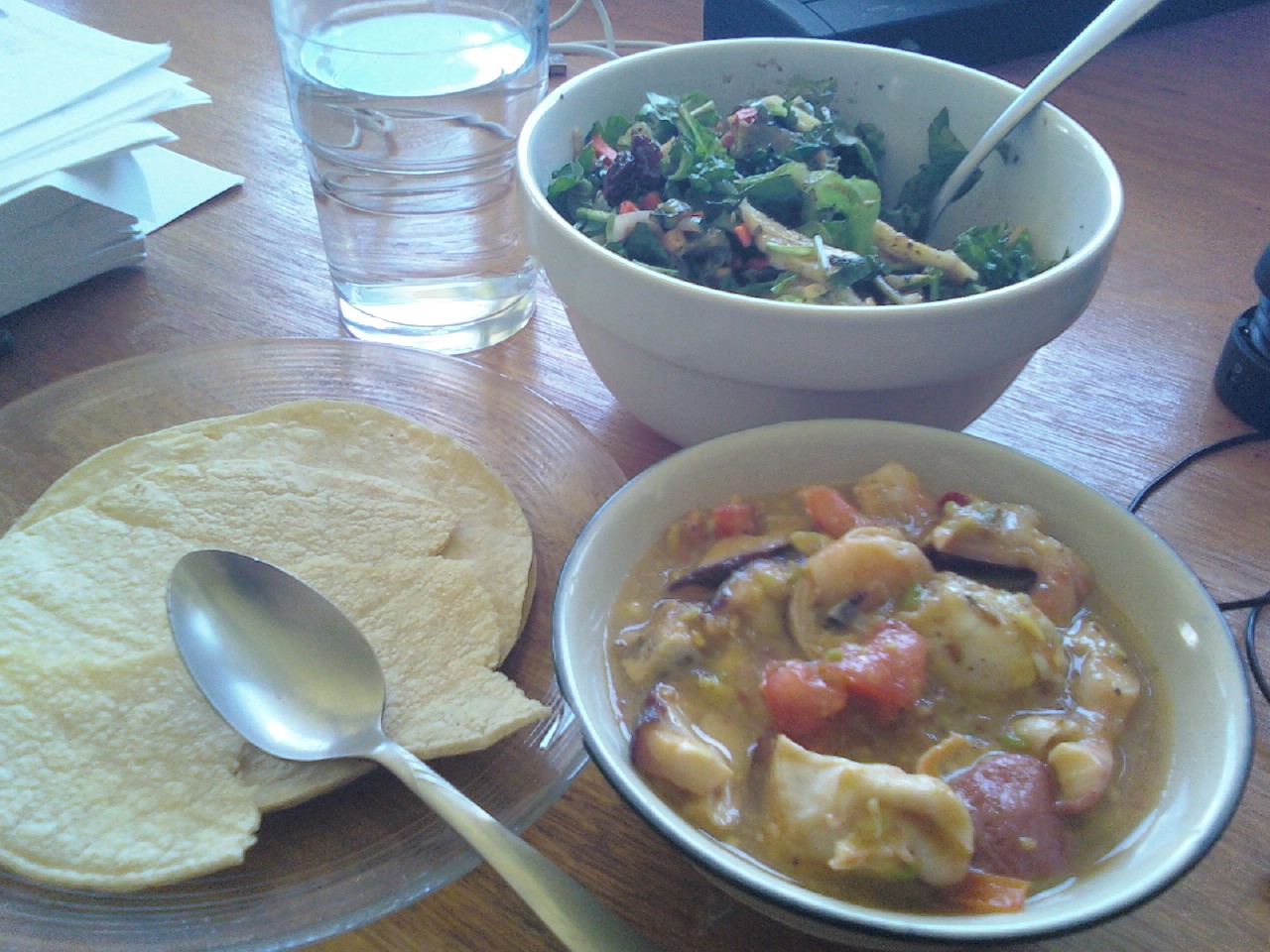
There comes a time when every soul must face the inevitable question: what recourse is left one when one has a hankering to whip up a homemade poke, only to discover that the supermarket is completely out of ogo?  Well, what happened to this dream deferred was a channeling of that desire for minimally processed seafood into another cultural milieu.  All the mollusks and crustaceans I had stowed in my shopping basket (mussels, octopus, and shrimp, to be specific) were now destined to become part of a ceviche with a tomato and avocado base.  A disappointment this was not: in fact, I'd say this might have hit the spot better than the poke ever could have, given my erstwhile hankering for citrus.  Anyhow, here's the recipe, which is one of the simplest I've posted to date:  
  • ⅓ lb. pre-cooked mussels
  • ⅓ lb. pre-cooked cocktail shrimp
  • ½ lb. pre-cooked octopus
  • 1 large avocado, diced
  • 1 large beefsteak tomato, diced
  • 2 limes
  • 1 tsp. sesame seeds
  • 3 dried red chilis (medium to hot)
  • 1 Tbsp Tabasco sauce
  • ½ Tbsp. coarse sea salt (or to taste)
  • 2 tsp. coarse ground black pepper
  • 2 tsp. whole cumin seeds
  • 1 Tbsp. extra-virgin olive oil
Dice the mussels and octopus, and remove the tails from the cocktail shrip (should any chitin be present).  Toss the avocado, tomato, spices, sesame seeds, and seafood together in a large serving bowl.  Add the Tabasco sauce and olive oil and squeeze the juice from the limes into the mixture and mix thoroughly.  Set in the refrigerator to chill, preferably for an hour or two.  Serve cold with tortilla chips or warmed corn tortillas, along with perhaps a side salad and a piquant tempranillo.

    Peanut Butter and Jelly Sandwichfruit [V] [GF]

    Since it's been a while since my last post, I thought I might as get back into blogging by baby steps — and what could be more culinarily rudimentary than that perennial denizen of elementary-schoolers' lunch boxes, the peanut butter and jelly sandwich?  Well, things get a little bit more complicated, sandwich-wise, when one has a gluten allergy, and furthermore, it's not as if anybody needs instructions as to how to make this American staple.  Therefore, since 'ulu is in season here on O'ahu, I have decided to alter the traditional PB&J by analogy: since peanut butter, jelly, and bread combine to yield a peanut butter and jelly sandwich; peanut butter, jelly, and breadfruit clearly combine to yield a peanut butter and jelly sandwichfruit.  Thus, the Sandwich Islands truly are the sandwichfruit islands when 'ulu is in season!

    This recipe makes 4-6 servings, depending on what one considers a "serving" to be.  I recommend leaving the 'ulu ripen for several days after acquiring it before attempting it.  The fruit should be soft to the touch.  If the 'ulu is underripe, the resulting mixture will be extremely starchy and not nearly as flavorful.  Penzey's cake spice is a commercially available blend of cinnamon, star anise, nutmeg, allspice, ginger, and cloves.  Normally, I don't shill for packaged products, but for this one I'll make an exception on the dual grounds that it's a small, Minnesotan business and that this particular spice blend tastes like pure triturated ambrosia.  However, if this glowing endorsement doesn't constitute sufficient grounds for plunking down $3.29 (plus shipping and handling) for a 4 oz. jar, an 2:2:1 mixture of cinnamon, star anise, and nutmeg  will suffice.

    Fried breadfruit base: 
    • One medium 'ulu (i.e. breadfruit), ripe
    • 1½ Tbsp. vegetable oil
    • 2-3 cups water
    • 2 tsp. ground cinnamon
    • 1½ Tbsp. brown sugar
    • 1 tsp. Penzey's cake spice
    • Salt to taste
    Accoutrements (per portion):
    • 2 tsp. peanut butter
    • 2 tsp. jam or jelly
      Begin by heating the oil in a large teflon-lined frying pan on low to medium heat.  Chop the 'ulu in half, remove the stem, and cut away the meat of the fruit from the peel.  Cut that meat into half-inch chunks and sauteé for five minutes or so, until it is slightly (but not thoroughly) browned.  Add the spices, sugar, and some of the water, and over the next 45-60 min., continue periodically to stir the 'ulu chunks and incrementally add more of the water (every 5-10 min. or so) until all of the chunks are tender and the mixture could aptly be described as a thick, starchy paste.

      To serve, dish the mixture into small serving bowls and mix in the peanut butter and jam (for the latter, I've tried strawberry, pineapple-guava, and fig, and the fig wins hands down) and serve, adding additional water as necessary to give the mixture a creamy texture.  Additional water (and salt) almost certainly need to be added when the mixture is stored in a refrigerator and reconstituted.

      Thursday, June 9, 2011

      Borscht [V] [GF]

      I have no idea why, but I'd been developing a hankering for borscht — a soup I had never even so much as sampled before in my life — that had, by mid-March, trebled to a level which could no longer be endured.  Perhaps it had been a fascination with things traditionally Russian I'd developed since viewing the Met's production of Boris Godunov last autumn (featuring the formidable René Pape in the title role), perhaps it had been the fabulous photographs in the Russian Cooking volume in the old Time Life Books "Foods of the World" series, and perhaps it had been that one of my housemates had been on a beet-eating kick of late, and had been saturating the kitchen with the wonderful, rich aroma of boiling roots on practically a daily basis.  Still, whatever the impetus, it was time.

      Of course several allergen-avoidance adaptations in the typical recipes I'd perused (onions, for example, are typically present) had to be made, and after comparing several ingredient lists, I was able to distill the essence of what makes a good borscht.  Basically, the primary rule of thumb is this: if it grows near to or beneath the surface of the ground, throw it in the pot.  Beets, potatoes, carrots, cabbage, and whatever else of this ilk you might happen to have on hand do wonders for the soup (and if you don't react to allium vegetables like I do, I'd recommend chucking a few of those in the broth as well).  The secondary rule of thumb is not to skimp on the balsamic vinegar: it's the interplay of its sourness and the sweetness of the beets that lays the foundation for the soup's flavor.  The tertiary rule of thumb is that the traditional complement of smetana (or a reasonable facsimile) is de rigeur.  Interestingly enough, however, I've been able to manufacture a dairy-free substitute that, more or less, does replicate the flavor of sour cream passably well.  (Fulll disclosure: having never sampled echt smetana, which I've been told repeatedly by cognoscenti is in many ways unlike typical American sour cream, I'm not sure how well it stands up to authentic Russian product.)  The recipe for this has been included below as well.

      The borscht itself:
      • 4 small beets
      • 3 small red potatoes
      • 1 1/2 cups diced green cabbage
      • 1 medium carrot
      • 1 medium tomato
      • 1 Tbsp olive oil
      • 4 tsp salt (or to taste)
      • pepper to taste
      • 2 Tbsp fresh dill
      • 1/4 cup red wine vinegar (or to taste)
      The imitation smetana:
      • 1 tsp lemon juice
      • 1/2 cup silken tofu (firm tofu is preferable)
      • Salt to taste
      Peel the potatoes, then boil them together with the beets in a modicum of water until they're tender.  Remove the beets and potatoes and retain the water in which they were boiled as stock for the soup.  Dice the cooked beets and potatoes, the cabbage, the tomatoes, and the carrots and add them to the broth.  Add the vinegar, salt, pepper, and olive oil and simmer on medium heat for 30 - 45 min., or until the cabbage is soft and has grown slightly translucent.  Chop the dill and add it to the broth, then continue to simmer for 10 - 15 min. further.

      During these last 10 - 15 min., place the tofu, salt, and lemon juice in a food processor and process for 20 - 30 seconds until reasonably smooth.  Serve the borscht hot with a generous dollop of the smetana atop each portion.    


      Sunday, February 27, 2011

      Lemon Poppy Seed Quickbread [V] [GF]

      I've been somewhat obsessed with quickbreads lately, and after some fairly successful results with the carob-carrot-coffee-cake recipe I included in my last post, I figured it was time for some variations on the theme.  This specimen was also pretty tasty, so I figured I'd provide a recipe for this one as well.  Much of the ingredient roster will no doubt look familiar to anybody who has actually tried to put the last post's recipe into practice, but the texture is much lighter (due primarily to presence of the lemon juice), and the flavor is quite a bit lighter as well.
      • 2 cups rice flour
      • 2 apple bananas
      • 1 cup soy milk
      • 2 Tbsp. almond meal
      • 1 Tbsp poppy seeds
      • ½ Tbsp. baking soda
      • 1½ lemons
      • ½ tsp salt 
      • 1 Tbsp. raw turbinado sugar
      Preheat an oven to 350°.  Puree the apple bananas and soy milk in a blender.  Combine the remainder of the ingredients, excepting the lemons, in a mixing bowl.  With a grater, grate as much of the fresh lemon zest into the bowl as the lemon peels will yield, being careful not to include any of the bitter, white interior of the rind, then squeeze the juice from the lemons into the bowl as well.  Pour in the puree, and mix the batter together thoroughly with a spoon.  Take a large piece of aluminum foil and line the interior of a small baking pan with it, so that it conforms to the contours of the pan.  Grease the aluminum foil with vegetable oil.  Pour the mixture into the foil-coated pan and bake at 350° for 60-75 min.  Remove from the oven and allow the quickbread to cool for 15 min. or so, then peel off the aluminum foil, slice, and serve. 


      Thursday, February 24, 2011

      Carob Carrot Coffee Cake [V] [GF]

      There's a scene in Boris Godunov in which Boris, near the end of his reign and rope, passes through a crowd of peasants who implore him, in one of the opera's most visceral, haunting moments, for bread.  While I can't claim that this quickbread is capable of inspiring such reactions, some of those I've personally witnessed in response to its aroma alone, let alone its flavor, come pretty close.

      Well, perhaps that's a bit of an exaggeration, but at any rate, the recipe below yields a thick, hearty, brown loaf, a couple of slices of which would be capable of sustaining one through numerous hours of agrarian labor.  It packs a decent amount of protein (in tree nut form), and it also packs cinnamon and carob, which really seem to complement each other quite well... but enough empty praise and nutritional information!  Here's the recipe: 
      • 2 cups rice flour
      • 2 apple bananas
      • 1 cup soy milk
      • 2 Tbsp. almond meal
      • ¼ cup carrots, finely grated
      • ½ Tbsp. baking soda
      • ¼ tsp. cinnamon
      • ½ tsp salt 
      • 1 Tbsp. carob powder
      • 1 Tbsp. raw turbinado sugar
      • ¼ cup chopped walnuts
      • ½ cup raisins
      Preheat an oven to 350°.  Puree the apple bananas and soy milk in a blender.  Combine the rest of the ingredients in a mixing bowl, pour in the puree, and mix the batter together thoroughly with a spoon.  Take a large piece of aluminum foil and line the interior of a small baking pan with it, so that it conforms to the contours of the pan.  Grease the aluminum foil with vegetable oil.  Pour the mixture into the foil-coated pan and bake at 350° for 45 min. to an hour.  Remove from the oven and allow the quickbread to cool for 15 min. or so, then peel off the aluminum foil, slice, and serve.


          Friday, February 18, 2011

          Breakfast on Ice: a Survey of Fruits (Part 1)


          The selection of esoteric fruits readily available from your corner grocery in Honolulu is indeed staggering (as is, in the case of certain examples, such as the durian, the poor soul who has to transport those fruits home from said grocery), and I would feel remiss if I did not at least attempt to provide some sort of survey of this cornucopia.  Furthermore, I believe I have found the perfect excuse to do so, since he fruit smoothie is, really, the ideal breakfast food for hot climates, and has been the mainstay of my personal breakfast for two consecutive months now.  Therefore, today's post shall be the first installment of a vast survey of the fruits available in Honolulu markets (and especially in Chinatown, which has become my go-to place for inexpensive produce these days).  So, let the smoothie survey commence!

          Each day, or at least every couple of days, I generally try to vary the fruit which becomes the centerpiece of breakfast.  (However, that fruit is always pureed together with an apple banana, which provides some sweetness and substance without being too overpowering.)  Regardless of what the fruit of the day happens to be, my breakfast smoothies generally seem to end up with the "base" ingredients listed below, plus that fruit.  As a rule of thumb, the amount of the featured fruit to be used is whatever portion equals the size of the apple banana. 
          • 1 apple banana
          • 17 ice cubes (about 2 cups)
          • 1 tsp. raw cane sugar
          • 1 tsp. peanut butter
          • ½ cup water (plus extra, if needed to achieve the right consistency)
          • salt to taste
          So, on to this week's featured fruits!

          Longan

          That "long" in the first syllable is a translation of the Chinese word for dragon, and is the same morpheme that shows up, for example, in the name of the ubiquitous variety of green tea oft transliterated into Roman characters as "long ching" ("dragon well").  I confess I have not the sophistication of palate to distinguish the flavor of the longa from that of the lychee, though I take comfort in the fact that few whom I have polled do.  I take even greater comfort in the fact that that flavor is pretty damn tasty.  Longans seem to take quite well to dehydration, and result in pallid yet sweet and robustly-flavored "raisins" which outstrip the grape-based variety in nearly every aspect.  They're also fantastic iced, or chilled in simple syrup, and while they don't quite pack the same punch in a fruit smoothie that, say, a soursop or chiku does, they don't fail utterly in that department either.

          Cherimoya

          The cherimoya is, like the soursop, yet another one of those miraculous, delicately-custard-flavored New World fruits which seems to have found a worldwide audience in recent decades.  They're fantastic in smoothies, and pretty good on their own, too.


          Star Apple 

          The star apple, a.k.a. milk fruit, aguay, or caimito, is particularly striking in its appearance when halved perpendicular to its major axis (you'll immediately understand the origin of the name).  Nevertheless, despite the asterism and porphyrial hue, I confess that upon sampling my first specimen, I was not terribly impressed.  On the other hand, the subtle flavor seemed to complement well the apple banana in the smoothie to which I devoted the rest of the fruit I sampled, so it may be an item best taken in tandem with other fruits to bring out their flavoras — sort of the fructal equivalent of an aromatic spice.

          Chiku

          I have saved the best for last, for the chiku (a.k.a. sapodilla or chiko), is perhaps the emperor of fruits.  It originally hails from Central America, but has become a favorite in South Asia (whence the name "chiku").  Roughly the size an complexion of a kiwi (but without the cilia), its flesh, which ranges in color from ecru to deep orange, is sweet, yet not overpowering, and possesses a fascinatingly rich flavor whose nuances harmonize the best aspects of cantaloupe, egg custard, and chocolate.  The rind can be eaten as well, and it yields a distinctive, rich brown countenance to the smoothies one creates from it.  They're also just about the perfect serving size.  I heartily recommend that anyone seek out this fruit, which I believe, at present, unparalleled among nature's offerings.

          So that's it for this week's roundup, folks.  Stay tuned for further adventures involving soursop, papaya, pineapple (practically the state's unofficial mascot), and more in the coming weeks.         


          Friday, February 4, 2011

          Nián Gāo [V] [GF]

          Happy Chinese New Year, everybody!  It is now officially the year of the rabbit, so if you're looking for a method of ensuring good luck for the coming year that doesn't involve chopping off the token animal's foot, I have the solution for you: nián gāo.  Consuming these rice-flour cakes on Chinese New Year is said to ensure good fortune for the subsequent twelve months, much like its occidental equivalent, Hoppin' John (a dish with a name particularly appropriate for the year of the rabbit), it makes for a tasty way of seeing in the new year regardless of its efficacy as a good-luck charm.

          A variety of recipes for these cakes can be found online.  The version presented here is a fairly traditional one, save that the amount of sugar has been reduced (which partly accounts for the relative pallor of the confections appearing in the photo above, relative to your typical nián gāo).  Dried red dates are the traditional topping, but I happened to have dehydrated some halved longans earlier in the week, and they certainly did the trick.  Also, as far as steaming time is concerned: as you can see from the photograph, my steaming device is a somewhat inefficient piece of Rube Goldberg apparatus that allows plenty of steam to escape.  Therefore, if you have a real steamer, the steaming time given in the recipe below is probably a drastic overestimate.  Just keep an eye on the nián gāo as they steam.

          Good luck, bon appetit, and happy year of the rabbit!
          • 2¼ cups mochi rice flour
          • ¾ cups brown sugar
          • ¼ tsp. salt
          • 2¼ cups mochi rice flour
          • ¼ cup vegetable oil;
          • 1 cup water
          • 12-15 dried longans, dried red dates, or other dried fruit
          Place the sugar and water in a small saucepan and bring the water to a low boil.  Continue to boil the water, stirring occasionally, until the sugar has dissolved.  Once it has, remove from heat and set aside 15-20 minutes to cool.  Combine the rice flour and salt in a mixing bowl, and once the "simple syrup" has cooled to around room temperature, pour it into the flour-salt mixture, add the oil, and knead the ingredients together thoroughly.  Flatten the dough balls slightly with your hand, and press a piece of dried fruit into the top of each one.  On top of   Form the resulting dough into 12-15 small balls of equal size and place these on a well-oiled steaming rack and steam for 3-4 hours, or until the dough has been sufficiently steamed.  Set aside to cool for a while, then enjoy!